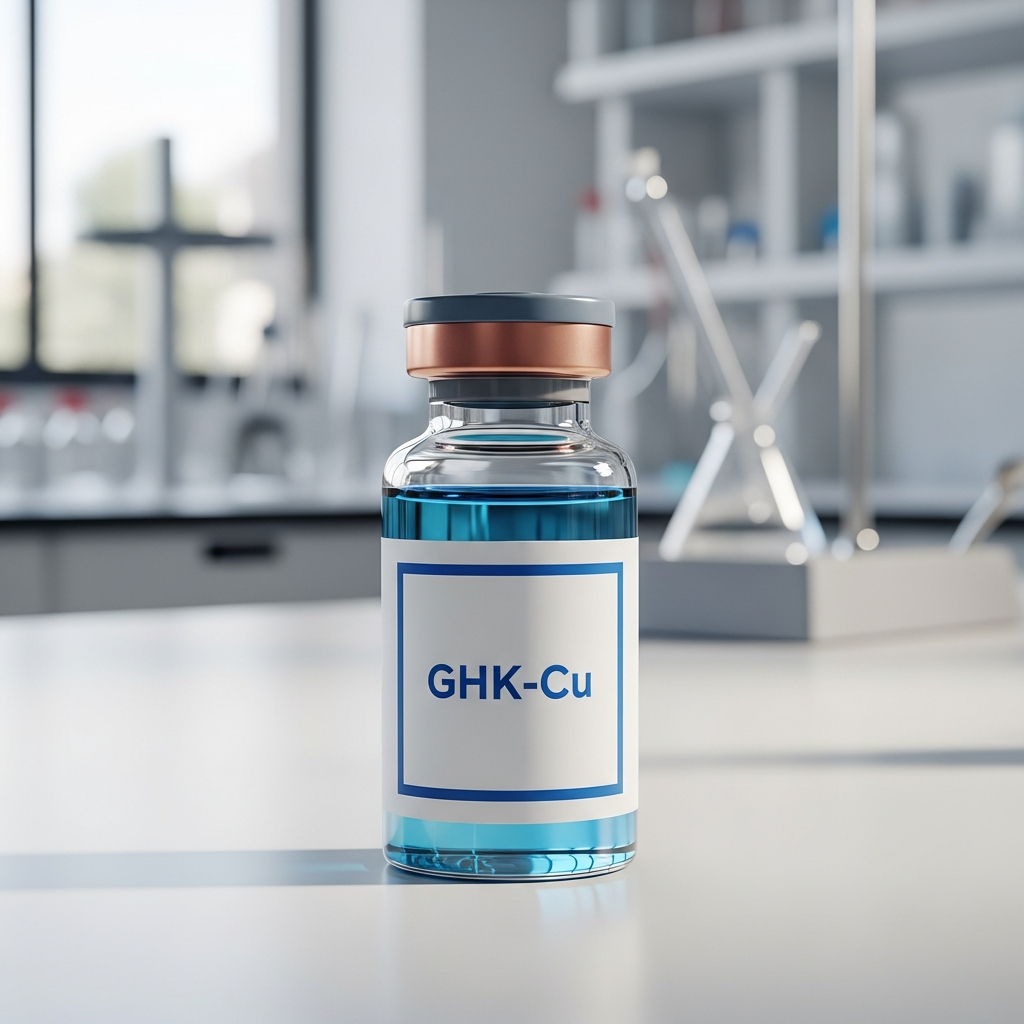
GHK-Cu Copper Peptide: The Science of Skin Remodeling and Hair Regrowth
Introduction: The “Fountain of Youth” Peptide
In the vast landscape of research peptides, few compounds have captured the imagination of scientists quite like GHK-Cu (Glycyl-L-Histidyl-L-Lysine Copper). Often called the “Blue Copper Peptide” due to its distinctive azure color, or the “Fountain of Youth Peptide” for its remarkable tissue regeneration properties, GHK-Cu stands as one of the most extensively studied peptides in dermatological and regenerative research.
Discovered by Dr. Loren Pickart in the 1970s, this small but mighty tripeptide has accumulated over 50 years of scientific literature supporting its role in skin remodeling, wound healing, hair follicle stimulation, and even anti-inflammatory signaling. Today, research institutions from India to Australia, from the UK to the USA, continue to uncover new applications for this versatile compound.
In this comprehensive guide, we’ll explore everything researchers need to know about GHK-Cu — from its molecular mechanism to practical research applications. Whether you’re investigating collagen synthesis, hair regrowth pathways, or tissue repair mechanisms, this article will serve as your definitive reference.
Looking to source pharmaceutical-grade GHK-Cu for your research? Buy GHK-Cu from Riserlabs — 99% purity guaranteed with FREE worldwide shipping.
The Discovery of GHK-Cu: Dr. Loren Pickart’s Breakthrough
A Serendipitous Finding
In 1973, Dr. Loren Pickart was studying liver cells when he made an unexpected observation. He noticed that older liver tissue, when exposed to young blood plasma, showed remarkable regenerative activity. The hunt was on to identify the responsible factor.
After years of meticulous isolation work, Pickart identified a small tripeptide — just three amino acids (Glycine-Histidine-Lysine) — that was responsible for much of this activity. More importantly, he discovered that this peptide had an exceptional affinity for copper ions (Cu²⁺), forming a stable complex that dramatically enhanced its biological effects.
This GHK-Copper complex (GHK-Cu) became the foundation for decades of regenerative research.
Why Copper Matters
Copper isn’t just a “helper” in the GHK-Cu complex — it’s essential to its function. The copper ion:
- Activates key enzymes like lysyl oxidase (critical for collagen cross-linking)
- Enhances antioxidant defenses through superoxide dismutase activation
- Modulates gene expression affecting tissue repair and remodeling
- Enables cellular uptake of the peptide through specific transport mechanisms
Without copper, GHK is significantly less effective. This is why research-grade GHK-Cu (with the copper already chelated) is preferred for laboratory studies over unconjugated GHK peptide.
The Science of GHK-Cu: Mechanisms of Action
1. Collagen Synthesis and Skin Remodeling
Perhaps the most celebrated property of GHK-Cu is its ability to stimulate collagen production. Research has demonstrated that GHK-Cu:
- Upregulates Type I and Type III collagen synthesis in fibroblasts
- Activates decorin production — a proteoglycan essential for collagen fibril organization
- Increases elastin production for skin elasticity
- Stimulates glycosaminoglycan synthesis (including hyaluronic acid precursors)
- Promotes fibroblast migration to areas requiring tissue repair
The net effect? Skin tissue exposed to GHK-Cu shows improved organization, increased thickness, and enhanced structural integrity.
2. Wound Healing Acceleration
GHK-Cu’s wound healing properties have been extensively documented:
- Accelerates re-epithelialization — the process of skin cells covering a wound
- Promotes angiogenesis — formation of new blood vessels to supply healing tissue
- Attracts immune cells to clear debris and prevent infection
- Reduces scarring by promoting organized collagen deposition vs. random fibrosis
- Decreases inflammation after the initial healing phase
Studies have shown wounds treated with GHK-Cu formulations heal significantly faster with improved cosmetic outcomes.
3. Hair Follicle Stimulation and Hair Growth Research
One of the most exciting areas of GHK-Cu research is its potential in hair regrowth. The mechanisms include:
- Increases dermal papilla cell proliferation — the “command center” of hair follicles
- Prolongs anagen phase — the active growth phase of hair
- Improves follicle vascularization — better blood supply to hair roots
- May inhibit DHT — the hormone associated with pattern hair loss (though this mechanism is still under investigation)
- Stimulates Wnt pathway signaling — critical for hair follicle cycling
Research comparing GHK-Cu to other hair growth compounds has shown promising results, particularly in combination with other peptides.
4. Anti-Inflammatory and Antioxidant Effects
GHK-Cu doesn’t just build — it also protects:
- Reduces inflammatory cytokine production (IL-6, TNF-α)
- Activates antioxidant enzymes (SOD, catalase)
- Neutralizes reactive oxygen species
- Protects against UV-induced damage
- Reduces lipid peroxidation in cell membranes
These protective effects complement the regenerative properties, creating an environment conducive to tissue healing and maintenance.
GHK-Cu vs. “Cosmetic Grade” Copper Peptides: Why Purity Matters
Not all copper peptides are created equal. When sourcing GHK-Cu for research, understanding the difference between cosmetic-grade and research-grade peptides is critical.
| Factor | Cosmetic Grade | Research Grade (Riserlabs) |
|---|---|---|
| Purity | 70-85% typical | >99% HPLC verified |
| Contaminants | May contain salts, solvents | Minimal impurities |
| Copper Ratio | Variable | Consistent 1:1 chelation |
| Documentation | Basic or none | Full CoA with HPLC, MS |
| Batch Consistency | Variable | Lot-to-lot verified |
| Price | Lower | Premium (reflects quality) |
| Suitable for Research | No | Yes |
For reproducible research results, purity is non-negotiable. Impurities can confound results, introduce variables, and compromise the validity of your studies.
Riserlabs provides pharmaceutical-grade GHK-Cu at 99%+ purity — view our GHK-Cu products with full Certificates of Analysis.
Research Applications: What Scientists Are Studying
Dermatological Research
- Anti-aging mechanisms — how GHK-Cu reverses skin aging markers
- Scar remodeling — converting hypertrophic scars to normal tissue
- Photodamage repair — reversing UV-induced skin changes
- Dermal wound healing — optimizing healing protocols
Hair Biology Research
- Androgenetic alopecia — pattern hair loss mechanisms
- Follicle stem cell activation — hair regeneration pathways
- Combination therapies — GHK-Cu with minoxidil, finasteride alternatives
- Hair transplant optimization — improving graft survival
Regenerative Medicine
- Bone healing — GHK-Cu effects on osteoblasts
- Cartilage repair — chondrocyte stimulation
- Nerve regeneration — neurotropic effects
- Organ tissue repair — liver, lung, kidney regeneration studies
Cosmetic Science
- Formulation development — optimal delivery systems for GHK-Cu
- Combination products — synergies with retinoids, vitamin C, other peptides
- Stability studies — maintaining GHK-Cu potency in formulations
Why Researchers Choose Riserlabs for GHK-Cu
Premium Quality, Global Delivery
As a trusted peptide supplier based in India, LyzeLabs serves research institutions across USA, UK, Europe, Australia, Singapore, UAE, and beyond. Our GHK-Cu is manufactured to pharmaceutical standards:
- >99% Purity — HPLC verified with full documentation
- Proper Copper Chelation — consistent 1:1 GHK:Cu ratio
- Lyophilized Format — maximum stability and shelf life
- Cold-Chain Shipping — peptide integrity maintained during transit
Research-Ready Variants
We offer GHK-Cu in configurations suited to different research scales:
- GHK50: 50mg × 10 vials — Standard research protocols
- GHK100: 100mg × 10 vials — Extended studies
Volume Pricing for Institutions
Large-scale studies require substantial quantities. Our 8-tier volume pricing makes extensive research economically viable — check current pricing.
Storage and Handling for Optimal Research Results
Lyophilized (Powder) Form
- Storage Temperature: -20°C long-term, 2-8°C short-term
- Stability: 2+ years at -20°C if sealed
- Light Sensitivity: Store in dark; copper peptides are photosensitive
- Humidity: Keep desiccated; moisture degrades peptides
Reconstituted Form
- Reconstitution: Use sterile bacteriostatic water or appropriate buffer
- Storage: 2-8°C after reconstitution
- Stability: Use within 2-4 weeks depending on protocol
- Avoid: Repeated freeze-thaw cycles